Robots Rescue Janáček's Flop Opera at Janáček Brno Festival 2026
Janáček's four-performance flop of 1894 returned at the Janáček Brno Festival with robots, a stellar Adriana Banásová and a staging that rescued the banal libretto from itself.

Programme
- The Beginning of a Romance premiered in 1894 and was dropped after four performances.
- The Janáček Brno Festival 2026 staged all nine Janáček operas, including this rarest one.
- The production was a co-production of the National Theatre Brno, Hausopera and Brno University of Technology.
- Adriana Banásová starred as Poluška opposite Raman Hasymau's robot Adolf.
- Janáček completed Jenufa, his next opera, in 1903.
Leoš Janáček's least-known opera, "The Beginning of a Romance," received a rare outing at this year's Janáček Brno Festival — mounted with robots, a scooter-riding baritone and one genuinely complete portrait from soprano Adriana Banásová. The work premiered in 1894, survived four performances, and never recovered. Even the composer disowned it as an "empty comedy."
The festival staged all nine Janáček operas, including this one-act curiosity of roughly 50 minutes. The libretto bears most of the blame for its failure. Librettist František Rypáček published under the pseudonym Jaroslav Tichy, which tells you something. The plot: peasant girl Poluška loves aristocrat Adolf; her father Jurásek intervenes; Adolf's father Haluzansky rejects the mismatch; Poluška settles for the peasant Tonek. That's it. The libretto insists "only equals should partner," a value today's audiences will not rush to defend.
Janáček didn't help. His score leaned heavily on Moravian folk melodies — songs, choruses, dances — and he knew it. He complained that "it was tasteless to force me to put folk songs into it." The result sits a long way from "Jenufa," completed in 1903.
How do you fix a dead libretto? Move it to the future.
The National Theatre Brno, Hausopera and the Brno University of Technology co-produced the staging. Director Marek Rihák reimagined the story in a near future where class prejudice has been replaced by a new divide: a techno-elite with AI, gadgets and humanoid facsimiles, and a traditional underclass that still mixes cake batter by hand. Adolf is now a robot. Haluzansky a scientist. Poluška, in program-note writer Patricie Častková's framing, raises the question of whether such a union should be feared.
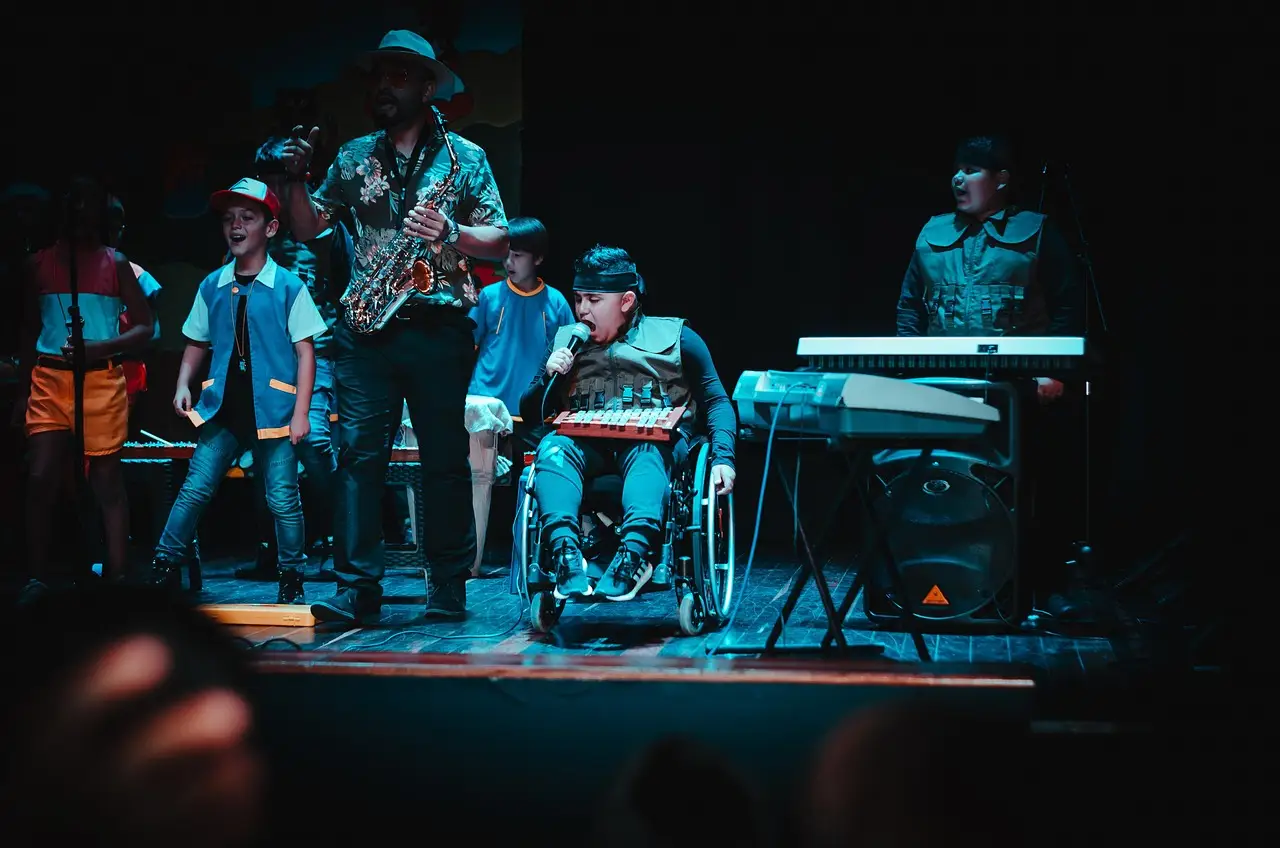
The reading worked on several levels. The love scenes between a mechanical man and a flesh-and-blood woman exposed the absurdities of the original text. Janáček's folksy music, now opposing the techno class, generated the tension the libretto never supplied. Visually, the staging delivered: an inert robot on the back wall, a remotely controlled plant, Adolf in a silver overall walking like a machine while singing with human passion. A robotic dog, built by university students, tried to bite Jurásek when he suggested Adolf marry Poluška. Haluzansky entered on a two-wheeled device, arms folded, circling the stage while Jurásek watched in semi-bewilderment.
Zora Davidová's costumes split the worlds — peasant-tinged normality against silver and white scientific overalls. Tomáš Rusin's stage design folded the robotic devices into the action without fuss.
Did the venue help?
Not really. The courtyard hall inside the university building offered good sightlines from five or six raked rows and little else. Singers wandered to staircases and balconies; the orchestra sat half-buried in an alcove. Echoes bloomed and, depending on a singer's position, the connection between voice and pit vanished entirely. Before conductor František Krepele could begin, a wheeled robot delivered his baton. Nice touch. He and the Czech Virtuosi orchestra still produced a lively, rhythmically engaging account of the folk-inspired score — music that recalled Smetana and showed barely a hint of the brilliance coming in "Jenufa."
Who stood out?
- Adriana Banásová (Poluška): the evening's star. She mixed innocence with common sense, hope with resignation, and moved her voice freely, colourfully, with clear articulation and emotional depth.
- Jiří Sulženko (Jurásek): a bold, well-sung portrait of the anxious father; his complaint scene was a high point.
- Vladimír John (Tonek): thin and distant when entering from the balcony, overpowered by Banásová; he recovered to finish passionate and clear.
- Raman Hasymau (Adolf): suitably detached acting, resonant and expressive singing — the role's built-in absurdity made it work.
- Daniel Kfelíř (Murdock): subtle, flexible, authoritative; a voice built for villains, wasted on a part this small.
- Daniela Straková (Jurásková): tidy and well-sung.
- Alžběta Symerská (Countess Irma): sensitive phrasing as a robot programmed to love.
- Josef Škarka (Halužanský): cold, condescending, dismissive — in other words, exactly right.
- The Brno University of Technology Choir, Vox Iuvenalis, sang its short choruses with forceful energy.
Against all expectations, "The Beginning of a Romance" proved not without quality. Opera is a theatrical event first, and with a libretto this banal, pleasant but commonplace music alone could never have saved it. The production team's imagination did. Whether the work now earns future performances is another question — but the festival has at least given Janáček's flop its first serious argument for a second life.
Source: Opera Wire
More from Daniel Okafor
Show full bio
News editor covering companies, deals and strategy in arts in the broadest sense at Arts & Voices.
1,683 articles