Asmik Grigorian's Fearless 'Jenufa' Opens a New Met Production
Asmik Grigorian never leaves the stage in Claus Guth's new Met 'Jenufa,' and Sean Panikkar's late-switch Laca matches her intensity. The production runs through Dec. 4.
Programme
- The Metropolitan Opera's new 'Jenufa,' directed by Claus Guth, opened Monday and runs through Dec. 4.
- Soprano Asmik Grigorian sings the title role; Guth premiered this production with her in London five years ago.
- Sean Panikkar made his role debut as Laca after Allan Clayton withdrew; Ryan Capozzo debuted as Steva at late notice.
- Tomas Hanus made his Met conducting debut; Nina Stemme sings the Kostelnicka.
- The New York Times named the production a Critic's Pick.
The Metropolitan Opera's new "Jenufa," which opened Monday night, is a Critic's Pick for one reason above all: Asmik Grigorian never leaves the stage, and you never want her to. Joshua Barone, reviewing for The New York Times, calls the soprano's title-role performance fearless and ferocious — the qualities Leos Janacek's 1904-vintage vocal writing, a marriage of declamation and melody, effectively demands.
Janacek's libretto abandons poetry for raw, rapid-fire drama. That, Barone argues, invites something beyond a typical opera performance. Grigorian delivers it. Her silvery, focused sound carries across the house yet holds control at a wire-thin whisper. When Jenufa shouts the name of Steva, the rakish father of her secretly expected child, Grigorian's cry shifted from ecstasy to tender love within a single held note.
What makes Grigorian's performance exceptional?
She phrases not just note to note, but across entire scenes. In the Act II soliloquy — nightmarish anxiety and prayerful hope by turns — she proved frenetic and radiant at once. Barone's verdict is blunt: few singers can match her dramatic intelligence.
Her physicality matches her voice. She tussles playfully with Laca, the man in love with her, and lets herself be carried by drunk soldiers in a folk dance choreographed by Teresa Rotemberg. Subtler still is the facial work: with her eyes she processes the news of her infant's death, and she suppresses smiles through her wedding day's motions with underlying sadness. It is acting of cinematic detail, which may not reach the farthest corners of the Met's auditorium. The moment still lands.
How does Guth stage a Moravian tragedy?
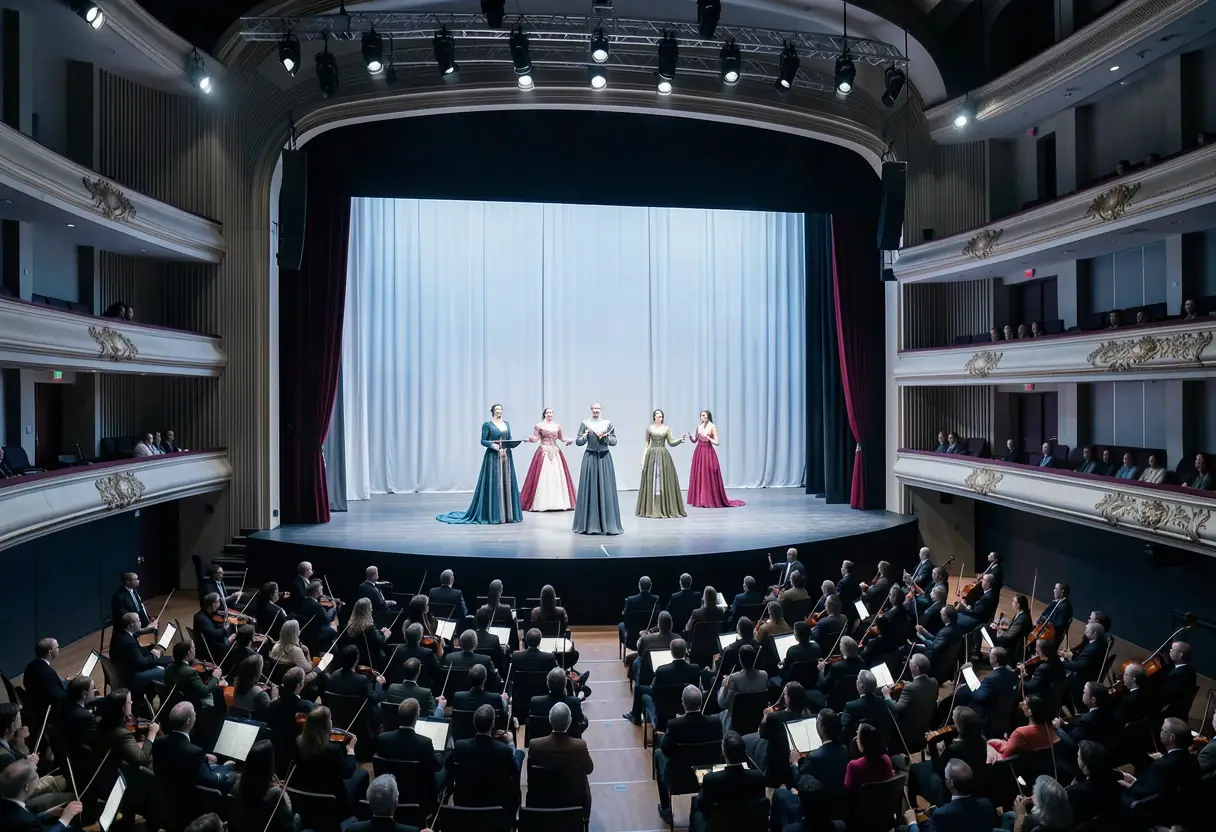
Director Claus Guth premiered this production with Grigorian at the Royal Ballet and Opera in London five years ago. His psychologically direct staging seems built to give her room. With set designer Michael Levine, he renders the tight-knit Moravian village as a cavernous room lined with whitewashed wooden slats — a live-work space from hell, containing a mill and dormitories, with no apparent exit.
It's a busy plot:
- Jenufa's stepmother, the Kostelnicka (sacristan), bars her from marrying Steva until he stays sober for a year
- Laca, in jealous rage, accidentally slashes Jenufa's face
- In hiding, Jenufa gives birth to a boy; the Kostelnicka drowns him in a frozen stream to save her reputation and secure a marriage to Laca
- Everything erupts at the wedding
The action flows vividly in Tomas Hanus's Met conducting debut. Gesine Völlm's 19th-century-realistic costumes sit inside symbolism: Act I bed frames turn upward into a cage for Act II, a raven perches above as a harbinger of death, and Act III's bare stage fills with yellow flowers under James Farncombe's sunny lighting — fragile renewal, and the spring thaw that will expose the Kostelnicka's crime.
Who else anchors the cast?
Nina Stemme is ideally suited to the Kostelnicka. Her voice, like Grigorian's, is not naturally warm; even her sweetness has a hard edge. In the Act II soliloquy "Co chvila," thinking through killing the baby to cover her lie, Stemme sang with clenched fear and eruptive force. By the end, Barone writes, you believed her belief that a crime can be an act of compassion.
Casting shuffled late: after Allan Clayton withdrew, Sean Panikkar switched from Steva to Laca (a role debut), and Ryan Capozzo took Panikkar's place as Steva. Capozzo, boyishly bright-voiced, flung phrases around carelessly — an impressive role debut at late notice.
Panikkar, though, is the marvel. His Laca begins as a forgotten man, overworked and hatefully jealous, chilling as he decapitates Jenufa's flowers with a newly sharpened knife. After scarring her, horrified and remorseful, he becomes redemption personified — protecting her from the village mob and remaining at her side even as she tries to set him free. In his love declarations he sang with Italianate yearning and gentle beauty.
Whenever Panikkar and Grigorian shared the stage, they performed like a match held over a powder keg. Fittingly, Guth ends his production with the two of them alone, stepping out of the whitewashed room onto the soil beyond. They are enough for each other — and reason enough, per Barone, to see this "Jenufa," which runs through Dec. 4 at the Metropolitan Opera in Manhattan.
Source: NYT Arts
More from Daniel Okafor
Show full bio
News editor covering companies, deals and strategy in arts in the broadest sense at Arts & Voices.
1,510 articles