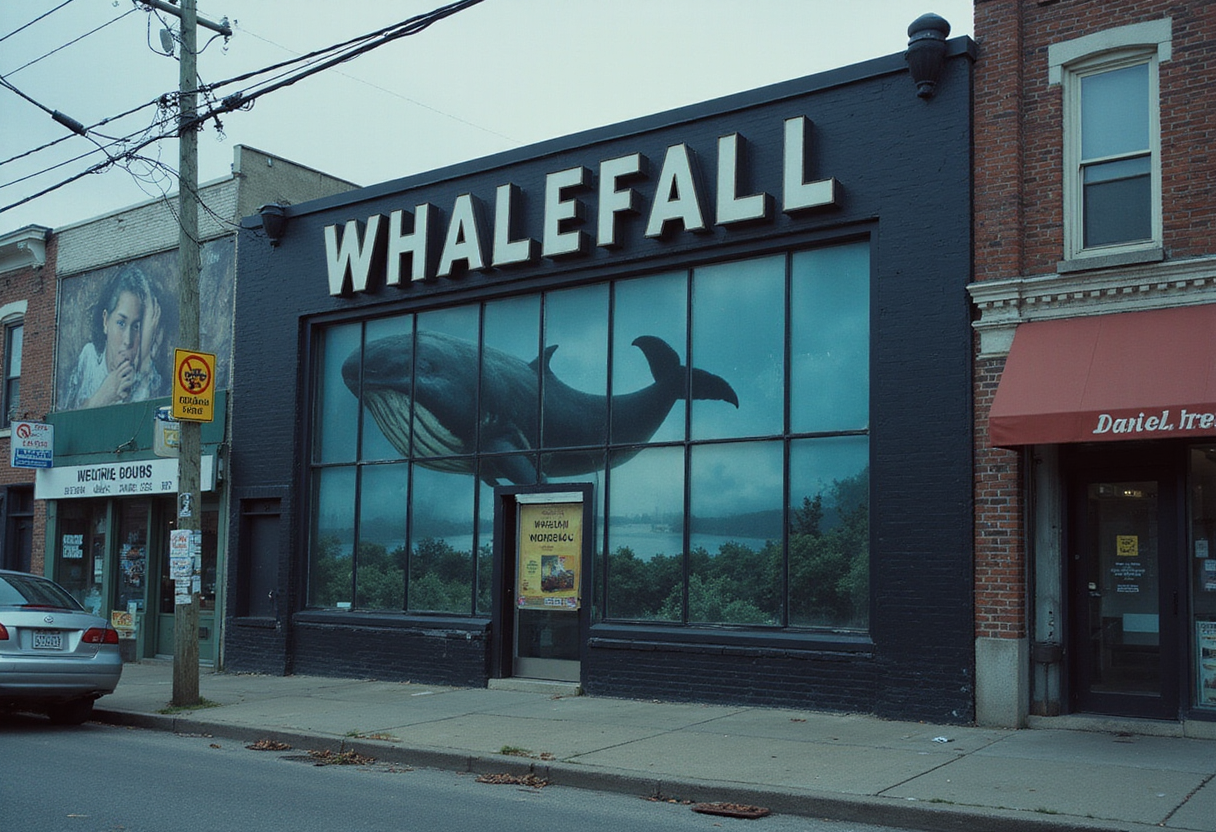
Whalefall Review: Austin Abrams Gets Swallowed, and So Does the Drama
Austin Abrams stars as a grieving son swallowed inside a whale in Whalefall, a family drama critics call "too literal for its own good." The metaphor becomes anatomy.
Programme
- Austin Abrams plays the lead role of a grieving son in Whalefall
- The plot follows the son's search for his father, ending inside a very large mammal
- The review's verdict: a family drama "too literal for its own good"
- The critic frames the film as a metaphor rendered literally, at the story's expense
Austin Abrams plays a grieving son who ends up trapped inside a whale in Whalefall, a family drama the review's critic judges "too literal for its own good."
The premise is simple. A young man searches for his father. The search takes him into the ocean. The ocean, in the most physical sense possible, takes him in. Abrams, known to television audiences from long-running ensemble casts, carries the film as its emotional center: a son working through grief inside the belly of the beast the title names.
The review's verdict is blunt. The critic writes that the film is "a family drama that's too literal for its own good." That phrase does the critical work here, and it deserves unpacking, because it identifies a specific failure mode rather than a general one.
What does 'too literal' actually mean here?
It means the metaphor stops being a metaphor. Grief that swallows a person; a father lost, a son consumed; the ocean as the unconscious — these are rich symbolic materials. Whalefall, in the critic's reading, stages them as physical fact. The son is literally inside the mammal. The loss is literally a body in the water. When a film renders its metaphor as anatomy, the audience has nothing left to interpret. The beast's belly is not an image of despair. It is a location.
That literalism, the review implies, flattens what should be the film's emotional engine: the father-son relationship. A grieving son in search of his father is durable dramatic material. Trap him in a whale and the drama risks becoming spectacle, the family story reduced to a survival scenario.
What does this change for the film's audience?
Practically: adjust expectations. Viewers arriving for a family drama will find one wrapped in a high-concept survival premise, and the review suggests the wrapper overwhelms the contents. The critic's framing — a film "in the belly of the beast" that is itself consumed by its own conceit — signals that the ambition and the execution pull against each other.
A caveat belongs here, and not only the usual one. This review is one critic's judgment; other assessments may read the literalness as commitment rather than clumsiness. But the review itself leaves gaps worth noting. It names the lead actor and the premise. It does not, in the text available, name the director, the screenwriter, the runtime, the release date or the distribution platform. Readers weighing whether to watch will want those details before the film arrives — and until they surface, the strongest verified facts remain: Austin Abrams stars, the story follows a son searching for his father, and the action ends inside a very large mammal.
The closing judgment stands as delivered: the film is too literal for its own good. Whether that literalness reads as boldness or as a beached conceit will be settled by the audiences who go looking for it.
Source: NYT Arts
More from Tom Whitfield
Show full bio
Market editor covering people, launches and day-to-day practice in arts in the broadest sense at Arts & Voices.
569 articles