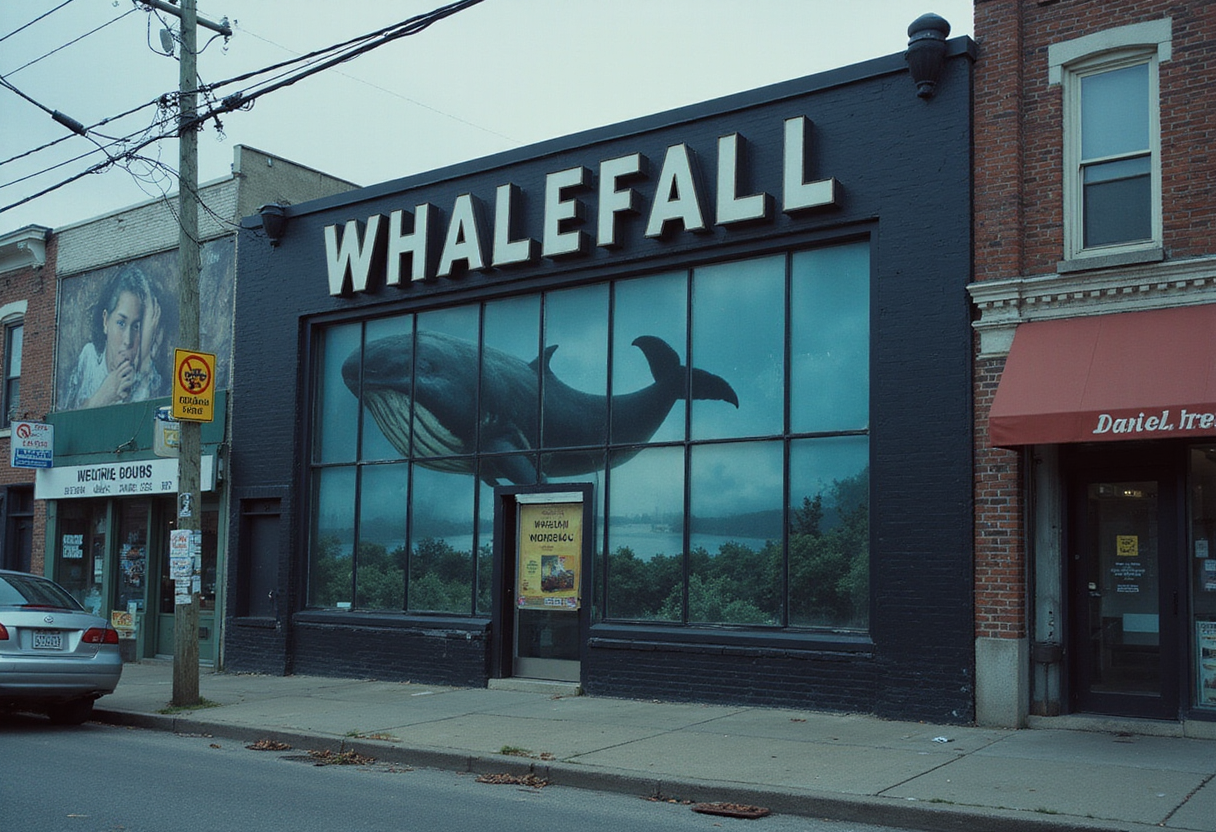
Whalefall Review: Austin Abrams Swallowed, and the Film With Him
Austin Abrams is swallowed by a sperm whale in Brian Duffield's 106-minute Whalefall, an overlong, flashback-heavy adaptation of Daniel Kraus's novel that only grips in moments.
Programme
- Whalefall runs 106 minutes and stars Austin Abrams in every scene.
- The film adapts Daniel Kraus's acclaimed novel; Kraus is a Pulitzer prize-winner.
- Brian Duffield directs; the Guardian review calls the adaptation 'rather soggy' and 'overlong'.
- This is Abrams's second studio lead role in a month, following the Resident Evil reboot.
Austin Abrams spends 106 minutes trapped inside a sperm whale in Brian Duffield's adaptation of Whalefall, and the film cannot make the premise hold.
The movie adapts Daniel Kraus's acclaimed novel. Kraus is a Pulitzer prize-winner, and his book earned a reputation that raised expectations for this studio version. Duffield, who directs, delivers what our critic calls a "rather soggy" translation to the screen.
The setup is simple and grabby. A young man, played by Abrams, is swallowed whole by a sperm whale. He must survive and escape from inside the animal. Our critic frames it as "what if that one scene in Finding Nemo but a whole movie" — a pitch that works for ten minutes and then, in the critic's judgment, stops working entirely.
What does the film get right?
The casting is the strongest asset. Abrams, an "immensely likable" alum of Euphoria, appears in every scene. The Guardian's review notes the HBO series has produced an unusual number of genuine stars, and Abrams belongs to that wave. This is his second studio lead role in a single month, arriving after the Resident Evil reboot, in which he endured what the critic calls "the world's worst, and gloopiest, courier assignment."
The review asks readers to "spare a thought" for the actor, whose month has now trapped him inside a whale. His performance, however, has limits imposed by the material. As the critic puts it, there is "not a great deal he can do" beyond screaming, writhing, and looking "understandably alarmed."
Where does it go wrong?
Three faults stand out in the review.
- Overlength. The critic calls the film "overlong" and "too overstretched" for a premise that suits a short shock, not a feature.
- Flashbacks. The adaptation leans heavily on flashback structure, breaking the claustrophobic tension of the whale's interior.
- Tonal strain. The film is "too silly" to keep viewers rooting for the hero's escape or invested in how he might orchestrate it.
The result, in the critic's words, is a thriller that "only has us on edge in moments" rather than sustaining dread across its runtime.
What does this change for Abrams and Kraus readers?
For Abrams, the answer is career momentum with a caveat. Two studio leads in a month confirm his ascent from television. Neither film, on this review's evidence, gives him material equal to his likability. For readers of Kraus's novel, the adaptation flattens a book the review treats as genuinely acclaimed into an adventure that strains credulity.
The film's failure also marks a caution for a current studio trend: high-concept survival stories stretched to feature length. Whalefall arrives with a literary pedigree and a marketable image — a man inside a whale — and demonstrates that neither survives the stretch to 106 minutes without sustained invention.
Original: x.com
More from Marcus Bennett
Show full bio
Staff writer covering people, launches and day-to-day practice in arts in the broadest sense at Arts & Voices.
535 articles