Art Market
Spring/Break Takes Over the Old CBS Newsroom With a Political Mission
Spring/Break's first edition at the old CBS News HQ, "Hide and Seek," centers on The People's Newsroom, a working podium run with the Slow Factory.
This weekend, for likely the last time, cameras are rolling at 555 West 57th Street.
The longtime headquarters of CBS News's most hallowed properties—60 Minutes and Inside Edition—was recently hollowed out in a Paramount acquisition that saw personalities and producers shuffled to a center across the street. Spring/Break, New York's most irreverent art fair, has taken residence. Its inaugural edition at 555 West 57th Street, titled "Hide and Seek," opened for previews yesterday. Roughly 120 exhibitors reanimate the office floor with the fair's regularly scheduled program of bombastic installations and impish figuration—all of it anchored by a special installation in the recording studios.
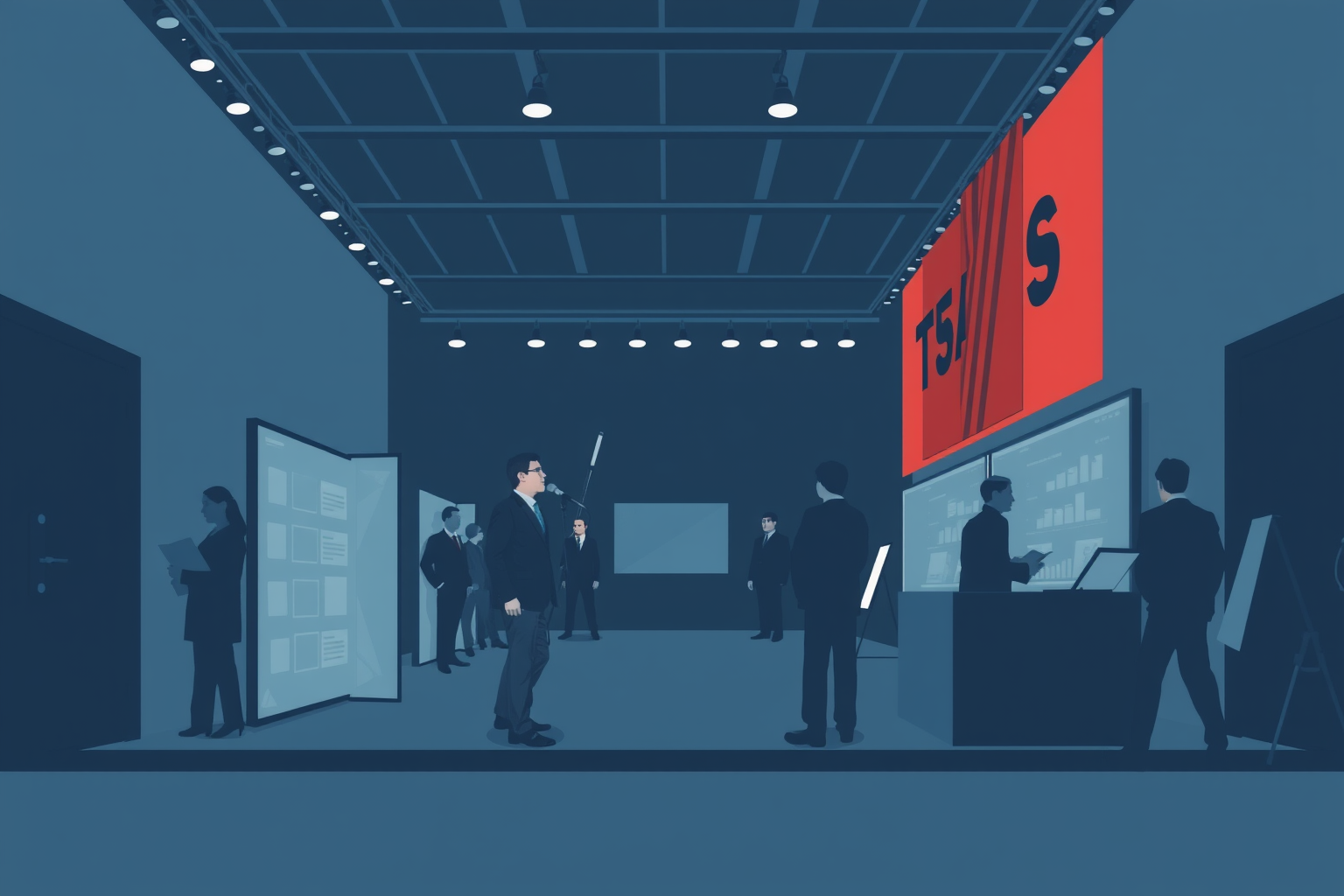
Titled The People's Newsroom, the installation was created with Spring/Break's 2026 creative partner, the Slow Factory, an environmental and social justice nonprofit founded in 2012 by Celine Semaan. It has since grown into a robust art, media, and education platform; MoMA PS1 hosted its pop-up lab in 2022. The Slow Factory's digital and print publication, Everything Is Political, is on site, too. Visitors, artists, and exhibitors alike can step behind a functional press conference podium, hit a big red button, and speak into the microphones. Their remarks play back on the monitor wall.
"As press access in the White House is currently being restricted because of the Trump administration and people are looking for uncensored perspectives, Everything Is Political is a space for anyone to report what they're seeing and what matters to them," the Slow Factory told ARTnews in a statement. The installation was organized as the White House press pool suspended coverage after the Trump administration barred CNN, MS NOW, and Politico from the White House. A court ultimately ordered the White House to lift the ban on those outlets. The consequence was immediate: on Monday, a White House video feed showed Trump speaking at a ceremony with no usable audio.
The People's Newsroom reports no such technical difficulty.
"Trump spoke to the U.N. and said that Iran had a choice between a deal or 'annihilation,'" read one woman into the thicket of microphones, adopting, unprompted, the sonorous cadence of a television news anchor. She addressed the audience trickling through the door: "Is it a sign of fascism?"
Indeed, they answered.
"Is it corporate consolidation?" she continued, shaking a paper at the camera. The stage includes printed prompts, but the program is purportedly free from censorship, according to Andrew Gori, Spring/Break's cofounder. Every segment is recorded and later analyzed; the "hidden gems," as co-curator Collis Browne put it, will be broadcast across social media and other channels.
"We wanted an unattended newsroom—a people's newsroom," Gori said. "The idea is that people are seeking a voice that isn't afraid to say the fundamental thing that's actually happening. If we're afraid to say what's actually going on—or, in the case of CBS, if they're beholden to larger socioeconomic and structural patterns—we can't do that."
As Gori framed it, "Hide and Seek" reveals a distinctly American political undercurrent with a little prodding. The administration's hostility to difference—in people, aesthetics, or identity—reads as a deadly game of chase, and uncovering the histories power hides is, for him, what artists are for.
"They're inseparable. No matter what your relation to power is, the political is about power," he said. "If someone says, 'No politics in art,' they have something to gain from a certain type of politics not being in art."
With such a cutting premise, only a handful of exhibitors earnestly confront the question. One is It's Not a Lie If You Believe It, a mixed-media installation curated by Liam Otero and Hannah Rothbard, featuring Rothbard alongside Lenna Christakis and Alungoo Xatan. It renders the deluge of communication and data that defines daily life as a visual cacophony of handmade paper, paintings, and photographs. Viewed up close, it suggests that some humanity endures: a tapestry of ID cards has a few smiling faces.
Elsewhere, the Asian immigrant artist duo Lily Honglei brought the fair's best paintings, On Moonlit River: Path of Immigrants. The impression is of stepping into a particularly vibrant dream, where the mundane and the divine mingle: on one canvas, a woman prunes a plant and a cook tends his stove amid a procession of celestial beings.
The most successful is Scorched Earth Tiki, a deceptively inviting "tiki bar" by writer Cara Sheffler and artist Johannah Herr, who together publish artist books as ¡AGITPOP! Press. Recipe books and shot glasses are for sale, but this is a classroom, not a vacation: each prop unpacks the Polynesian fantasy perpetuated by colonialism, obscuring the US's extractivist history in Vietnam, Hawaii, and the Marshall Islands. Even the dazzling string lights take the shape of mushroom clouds, alluding to nuclear testing in the Pacific.
As the booth's literature explains, the tiki bar—drawing its name from Māori mythology—was invented in 1930s California by a white American. From behind the bar, Herr mixed a mocktail and explained: "Tiki is the perfect metaphor for how Americans don't understand the rest of the world."
With the building's broadcast era ending, Spring/Break has converted the studios into a working platform for public speech—one whose "hidden gems" will circulate on social media long after the fair's last weekend in the old newsroom.
Source: ARTnews
Marcus Bennett
Show full bio
Staff writer covering industry trends and analytics at Arts & Voices.