English Touring Opera binds Ariadne and Dido in one double bill
English Touring Opera pairs Elena Langer’s Ariadne with Henry Purcell’s Dido and Aeneas, revealing shared emotional force in two abandoned heroines onstage.
Programme
- The double bill is scheduled for Malvern Theatres, Malvern, Worcestershire, on 14 November 2026.
- Elena Langer’s Ariadne is a 20-minute vocal chamber work from 2002.
- Henry Purcell’s Dido and Aeneas has first documented performances in 1688/9, associated with a girls’ school in Chelsea.
- The double bill joins Ariadne and Dido and Aeneas through their focus on abandoned women and private grief.
- Alex Robinson conducts the English Touring Opera Chorus and Orchestra.
By Grace Kim
English Touring Opera pairs Elena Langer’s Ariadne with Henry Purcell’s Dido and Aeneas at Malvern Theatres, Worcestershire, on 14 November 2026, according to Curtis Rogers’s review. Rogers describes Ariadne as a 20-minute vocal chamber work from 2002. He dates its first documented performances to 1688/9 and links the Chelsea girls’-school origins to Virgil’s Aeneid.
Rogers finds the pair’s mechanism in subject and scale. He calls their stories of abandoned women vivid, artistically influential episodes in Classical literature, compressed here into intimate music dramas. Their private grief replaces outward fury and revenge, and he hears Langer’s almost entirely one-voice piece as an extended lament mirroring Dido’s late lament, not a prelude.
Rogers treats both works as settings of English poetry. Glyn Maxwell wrote Langer’s libretto, while Nahum Tate supplied Purcell’s text.
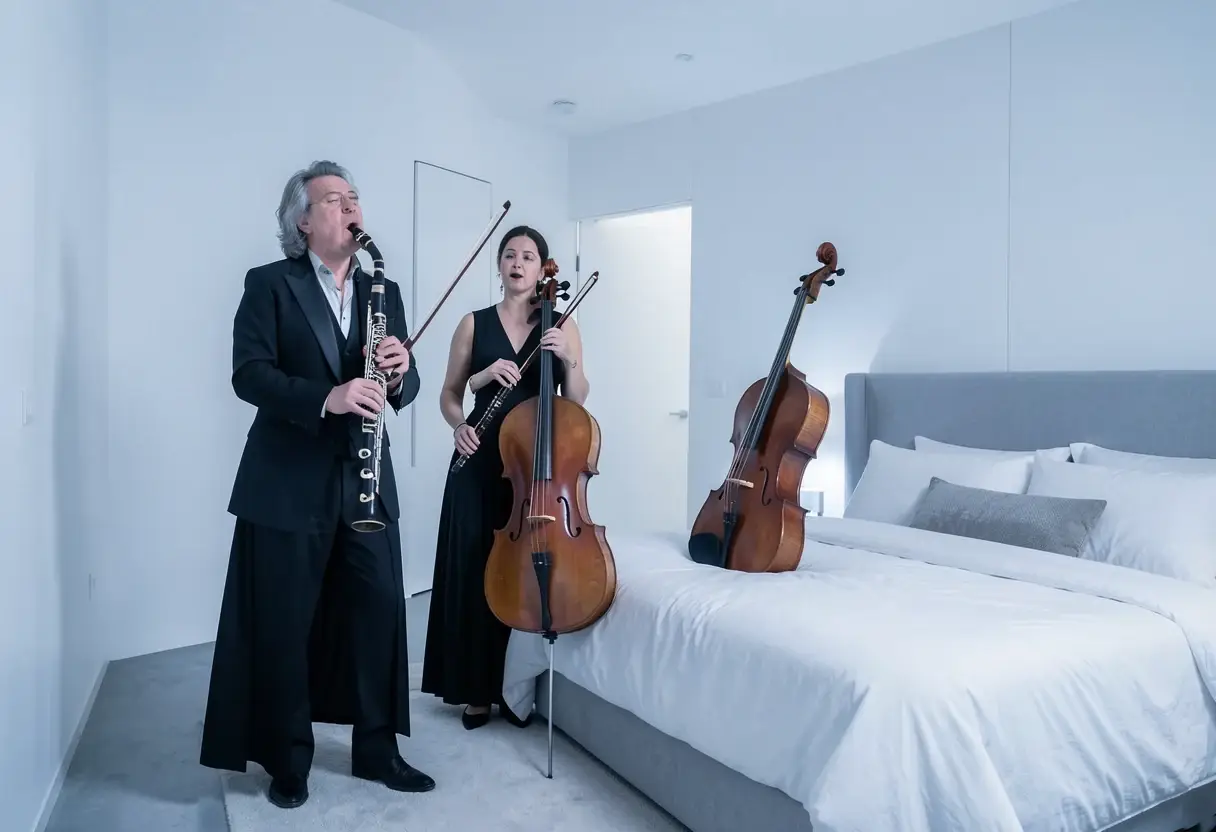
His formal comparison starts with Haydn’s cantata Arianna a Naxos. He finds Langer’s terse, epigrammatic style closer to late Britten and a development of Phaedra. In his reading, oboe, violin, viola and cello work as one ensemble: the strings create ambient space, while the oboe answers or mimics Ariadne’s vocal line.
Rogers describes the instrumental strand as “an emanation of her state of mind,” rather than an external frame for the drama. The soloists from the English Touring Opera orchestra foreground Ariadne’s direct confession with the exquisite calibration he praises. He also suggests Ariadne as a mythological sibling to Elle in Poulenc’s La voix humaine, another abandoned woman.
Anna Morrissey’s staging makes that psychology visible in Ariadne. The quartet sits behind Ariadne’s bed, a reduced image of Naxos, as Jessica Cale delivers her soliloquy from the bed. Rogers reads Cale’s thoughtful, incisive performance as troubled intimacy, with tension sustained despite the music’s low dynamic level.
Theseus begins in the bed, then leaves and wanders behind the quartet before vanishing, which Rogers reads as memory replacing real time. Kieron-Connor Valentine calls “Ariadne” offstage while Ariadne periodically addresses “Theseus.”
Rogers hears in Valentine’s distant, ethereal countertenor an allusion to Britten’s elusive Oberon and Apollo. The sound also leaves sonic space for Dionysus (Bacchus), who discovers Ariadne in the next mythic episode.
The thread that led Ariadne and Theseus out of the Minotaur’s Labyrinth remains as a tragic reminder of their severed bond. Rogers suggests its red colour may read as virginal blood when Ariadne later weaves it through her breast, an echo of Cleopatra applying an asp to herself.
Rebecca Meltzer carries that inward focus into Purcell by placing Dido on the same dais where Ariadne’s bed stood. After the death of her husband and the stirrings of new feelings toward Aeneas, Dido faces her courtiers’ scrutiny and apparent derision; they return as the witches in the same guise, although Rogers suggests they may be projections of her fears.
The Overture sustains a plaintive restraint, Rogers notes, before the lively tripping rhythm of “Fear no danger to ensue” breaks through. “Pursue thy conquest, Love” later supplies a pointed, spirited contrast to the score’s poetic mournfulness.
Meltzer preserves the opera’s feminine perspective by casting male ensemble singers as female members of Dido’s court in skirts; they later become the witches. Rogers connects this schoolgirl inflection to the work’s 1688/9 Chelsea origins. Their impish demeanor leaves Dido, in his reading, the only consciously adult character.
When the ensemble turn lusty sailors, they call Aeneas away from his amorous dalliance toward his destiny to re-found Troy. Rogers reads their lascivious behavior as demeaning, by association, the noble and sincere bond between Dido and the Trojan prince.
Alex Berry’s set and costumes use grey, ashen tones, sculptural rocks like huge lumps of charcoal, and X-ray-like panels resembling reproductions of the Turin Shroud without distinct figures or objects. Rogers reads these elements as the cinders of passion’s spent fire and a shroud awaiting a corpse.
Virgil’s Dido climbs a pyre, but this staging lets her leave with a dagger instead, suggesting a different fate. Rogers finds Samantha Price’s Dido dignified and reserved, while Isabelle Atkinson’s Belinda appears anxious. Lydia Shariff’s Sorceress stays cool, though Rogers hears insidious slides between notes; Atkinson and Alexandra Meier make the two Witches openly rebarbative.
Michael Lafferty’s Aeneas is aptly neutral and vacillating, which leaves Dido the central emotional role. Rogers finds Alex Robinson’s control of the English Touring Opera orchestra detailed and imaginative without drawing attention to itself. The ensemble comes into its own in the suave chaconne “Two in One upon a Ground,” interpolated from Dioclesian.
The people behind the double bill
- Ariadne: Elena Langer, composer; Glyn Maxwell, libretto; Jessica Cale, Ariadne; Kieron-Connor Valentine, Theseus.
- Dido and Aeneas: Henry Purcell, composer; Nahum Tate, libretto; Samantha Price, Dido; Michael Lafferty, Aeneas; Isabelle Atkinson, Belinda/First Witch; Alexandra Meier, Second Witch; Lydia Shariff, Sorceress; Kieron-Connor Valentine, Spirit; Guy Elliott, Sailor.
- Creative team: Anna Morrissey, director of Ariadne; Rebecca Meltzer, director of Dido and Aeneas; Alex Berry, set and costume designer; Joseph Hornsby, lighting designer; Haruka Kuroda, fight director for Dido and Aeneas; Alex Robinson, conductor; English Touring Opera Chorus and Orchestra.
What does the pairing change for opera audiences?
Rogers calls the production a “masterful demonstration of how music drama on the smallest scale can be as affecting as the grandest opera.” For audiences, the pairing changes the status of the 20-minute Ariadne: it is not a miniature prelude but a self-contained dramatic argument, with Dido extending its vocabulary of grief.
He says two otherwise unrelated works can form a cogent, unified pairing. The repeated dais, inward vocal focus and shared attention to abandoned women make that argument visible. Its practical consequence is clear: opera’s scale matters less than the emotional concentration of music and staging.
Source: operatoday.com
More from Grace Kim
Show full bio
Correspondent covering technology and product news in arts in the broadest sense at Arts & Voices.
1,596 articles