Feral Dogs and Nuclear Waste: Erin Johnson's Strange Ecosystems on Film
Erin Johnson's survey at the University of Georgia's Atheneum pairs feral dogs with nuclear weapons and botany with queer history in sensorial essay films.
Programme
- Erin Johnson's survey 'The Measure Is Something Else' is on view at the University of Georgia's Atheneum in Athens, curated by Rachel Waldrop.
- The exhibition title comes from a letter Rachel Carson wrote to Dorothy Freeman about monarch migration while dying of cancer.
- Credits across Johnson's films include contributions by Nikita Gale, Farah Al Qasimi, and Sondra Perry.
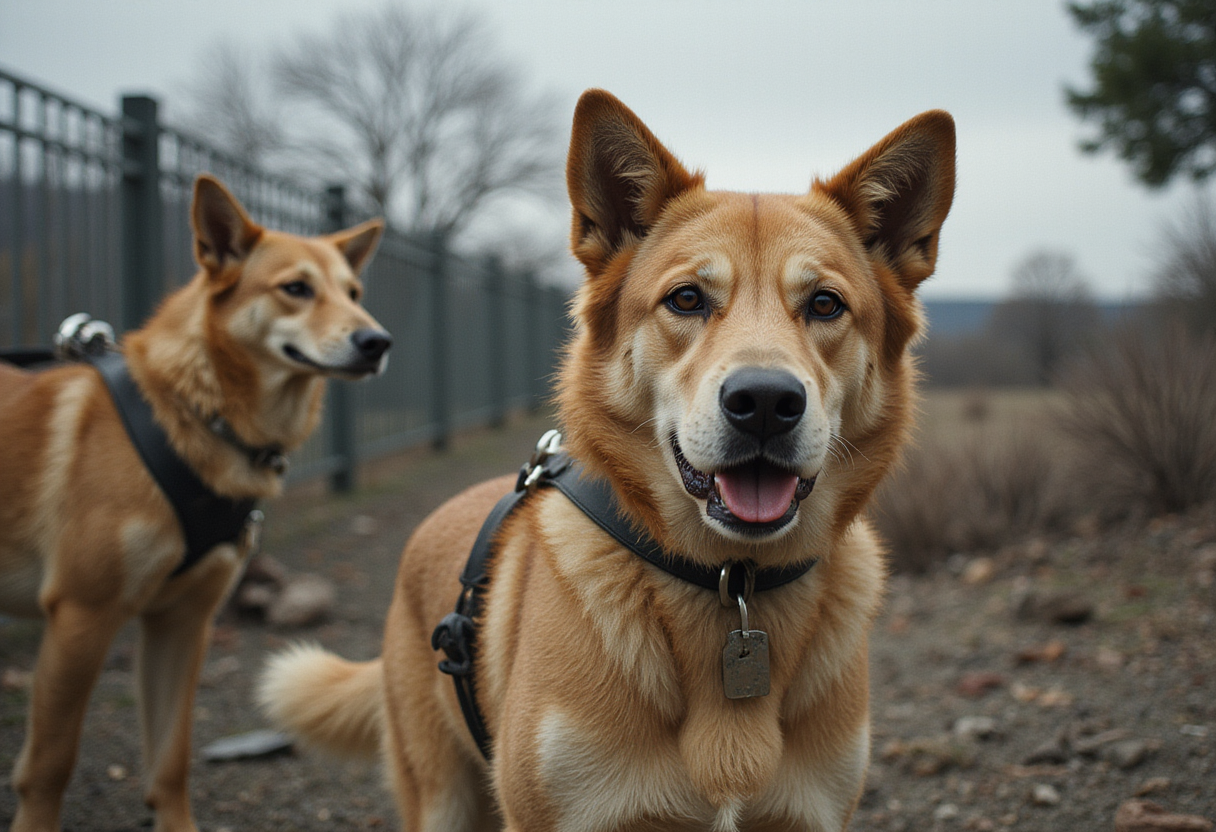
In Erin Johnson's two-channel film Heavy Water (2018), a mustachioed man poses a question about the first person to domesticate dogs. "They could grow up to eat your children," he reminds the viewer. The film cuts to his hand hovering before a slide projector displaying a plot of cheap land in South Carolina where nuclear weapons were developed during the Cold War.
The man onscreen is ecologist L. Lehr Brisbin. In the 1970s, according to the film, he noticed "unusual dogs with strange behavior" inhabiting that South Carolina lot. The animals were "gingerish" and Dingo-like—feral, rare, and, Brisbin says, carrying no European DNA. He began noticing their likeness in cave paintings, raising the possibility that the Carolina Dogs, a rare breed, have lived in the Carolinas for thousands of years. After environmentalists advocated for protecting the creatures, nuclear-weapons manufacturing on the site was halted. Scientists subsequently found several federally endangered species—birds and plants—thriving in the area humans had cordoned off.
Heavy Water anchors Johnson's survey "The Measure Is Something Else," now on view at the University of Georgia's Atheneum in Athens, curated by Rachel Waldrop. Like much of the work in the show, it functions as an essay film—but one that, rather than didactically demystifying the world, renders it sensorial and strange.
Johnson returns repeatedly to human interactions with other species. She films scientists: an oceanographer in 2022's To Be Sound Is To Be Solid, a botanist in 2026's The Ferns. She films animals and the humans around them: monkeys in 2024's Cayo Santiago, and Georgia's local legend "the goat man" in 2014's If it Won't Hold Water, It Surely Won't Hold a Goat. In Johnson's hands, the cold, analytical qualities typical of science and documentary film give way to something tender and embodied.
The exhibition's title comes from a letter Rachel Carson wrote to her lover, Dorothy Freeman, while dying of cancer. The subject was monarch migration. Carson observed that the butterflies' lifespan seemed short but understood that the measure is something else from their perspective.
A voice-over reads more of Carson's letters in There Are Things in This World that Are Yet to Be Named (2020), a film unfolding in sonic textures that much heady research-based art misses. Lines from the letters are chanted almost musically, repeating the refrain "there are so many things yet to be named" until its sense of wonder radiates. Meanwhile, botanists in a greenhouse reflect on how binary—and unscientific—thinking about gender brought unhelpful bias into plant classification, occluding our ability to understand the more marvelous ways plants reproduce. Their lab's research on a certain bush tomato exploded understandings of sexual normativity.
The show embodies ecosystemic thinking as much as it is "about" it—the idea that everything depends on and connects to everything else. No art form relies on interdependence more than film. When Johnson's credits roll, the list reads like an art-world roster: contributions by Nikita Gale, Farah Al Qasimi, and Sondra Perry. Filmmaking takes a village, and Johnson relies on friends.
Johnson trained at the alternative Warren Wilson College in Asheville, North Carolina, where students farm the food and manage the land. She directs an artist-run space in New York named Winnie, after her dog, and does dog-rescuing work—organizing and collaborating in art and in life.
That ethos becomes most visible in Tomatoes (2020) and Oranges (2023), where friends from the credits appear onscreen. A camera scans her Skowhegan cohort seated in a circle as they eat—tomatoes in a field in one video, oranges on a roof in the other. Viewers watch people—among them Tomashi Jackson, Annika Todd, and Chase Hall—simply eating. It feels surprisingly intimate, both sensual and silly as they slurp juices and spheres.
Interconnectedness abounds thematically as well. Juxtapositions of seemingly unlike topics—plants and gender, feral dogs and nuclear weapons—give way to Venn diagrams, with Johnson dwelling in the overlapping middles. In To Be Sound Is To Be Solid (2022), the artist talks on the phone to a scientist mapping the ocean floor while imagining the lives of the two women who built the Sea Ranch house she is renting—a midcentury marvel with fresh flowers, crisp bedding, and sleek bistro chairs. She finds hints the women were a couple: they drafted one version of the floor plan with just a single bedroom to share. Queer history can resemble the ocean floor—the scientist relays that, with hard data too scarce, the best one can do is average the depth of an area around 200 meters by 200 meters.
Johnson's is that rare, rich breed of research-based art that lets you marvel at how big and strange the world is—at how deep the ocean might be—enlisting science not to close down the mystery, but to open it wider.
Source: Art in America
More from Elena Vasquez
Show full bio
Senior reporter covering media and advertising at Arts & Voices.
282 articles