Jesus Christ Superstar puts 75 audience members on London stage
Jesus Christ Superstar places 75 viewers inside its Drury Lane set, while Rent arranges 82 audience seats onstage. The Guardian finds intimacy and strangeness when audiences sit inside the action.

Programme
- At Theatre Royal Drury Lane, Jesus Christ Superstar places 75 audience members within its scaffold-style set.
- The production’s Regent’s Park staging in summer 2020 kept actors and spectators two metres apart.
- Rent arranges 82 audience seats in an onstage semicircle at the Tom Stoppard theatre.
- Sam Ryder’s Gethsemane solo leaves the star beside an audience member’s feet.
- The Guardian’s wider wave includes High School Musical, Rent and Cloud 9.
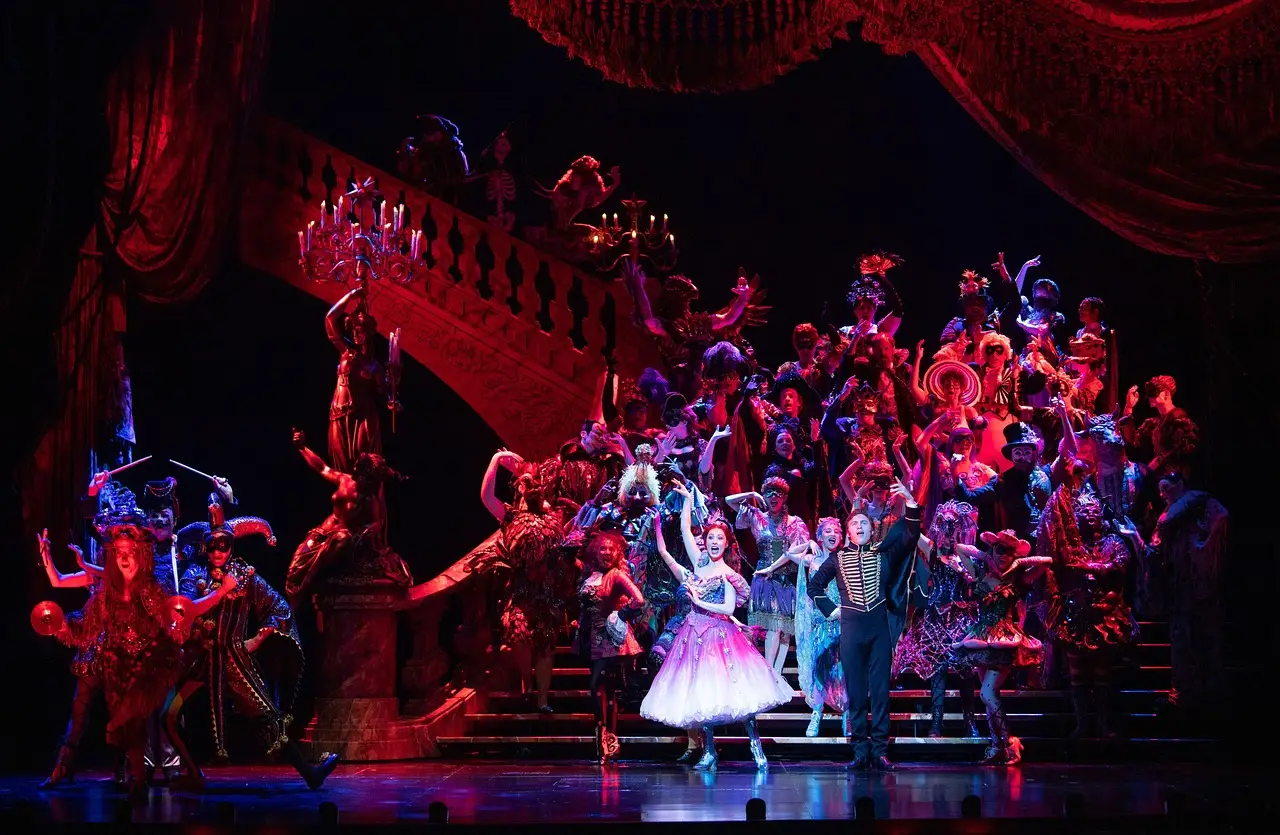
The Guardian reports that Jesus Christ Superstar has placed 75 audience members inside the scaffold-style set of its Theatre Royal Drury Lane revival. Spectators jostle beside other theatregoers, beneath the musicians and almost side by side with the cast.
The Guardian’s reviewer describes the production as miraculous and calls the experience “a triumphant but extremely strange experience.” The reviewer adds that it was “as close as I’ve been to the beating heart of a big West End production.”
The new viewing geometry
The Drury Lane staging revives the production previously staged at Regent’s Park in London during the socially distanced summer of 2020. That earlier audience was severely reduced, and spectators stood two metres from the actors.
The current staging changes the basic viewing geometry. Audiences occupy part of the scaffold rather than remaining beyond the stage edge, making distance part of the set’s composition rather than a fixed condition.
Within the set, the reviewer says, spectators feel the ensemble’s dance movements and seem to join Jesus’s followers and conspirators. Sam Ryder, the musical’s star, comes close enough to rest beside the reviewer’s feet after his solo Gethsemane.
That turns proximity from a front-row bonus into a structural part of the performance. Actors perform beside and around the audience, rather than only across a theatrical divide.
Rent’s onstage semicircle
The following week, the reviewer watches the captivating revival of Rent at the Tom Stoppard theatre. The reviewer occupies one of 82 audience seats arranged in a semicircle onstage.
Their seat sits just beneath a shelf bearing candle-filled wine bottles, a marker of La Vie Bohème. Stranger Things’ Gaten Matarazzo bounds past and onto the stage; the actors mingle with the audience, and the band remains just out of reach.
Rent uses a defined arc rather than the scaffold at Drury Lane. Audience positions become part of the stage picture, close enough for performers to move among viewers.
What does this change for theatregoers?
The practical change is the seat’s function. In Jesus Christ Superstar, an audience position brings the viewer beneath musicians, beside performers and near Sam Ryder’s Gethsemane solo.
In Rent, it places the viewer onstage within reach of the set, actors and band. The viewer no longer only observes from outside; proximity makes the audience part of the composition.
The reward the review makes clearest is sensory and social: immediacy, unusual access to choreography and a feeling of inhabiting the story. The possible cost is the loss of familiar separation, which helps explain why the same closeness feels so strange.
The Guardian places these productions within a wider wave that also includes High School Musical and Cloud 9. Its introduction says the shows put viewers alongside actors at the heart of the action.
For theatres making the change, the practical test is whether audience placement can deepen the performance without crowding out the work itself. The Drury Lane and Tom Stoppard examples offer two distinct arrangements, but both make the audience a visible part of the staging.
As High School Musical and Cloud 9 join that movement, the test is whether proximity can deepen a production without displacing its dramatic focus. In these examples, the audience has become part of the scene, not simply a new place to watch from.
Source: theguardian.com
More from Grace Kim
Show full bio
Correspondent covering technology and product news in arts in the broadest sense at Arts & Voices.
1,817 articles