Lisette Oropesa Saves a Bland Bellini at Barcelona's Liceu
Lisette Oropesa and Raffaella Lupinacci delivered vocal triumphs in Bellini's I Capuleti e i Montecchi at the Gran Teatre del Liceu, overcoming Allex Aguilera's uninspired staging.

Programme
- Bellini reportedly composed I Capuleti e i Montecchi in just over a month for the 1830 Venice carnival season
- The Liceu mounted a production imported from the Opéra Royal de Wallonie-Liège, directed by Allex Aguilera
- Riccardo Frizza conducted the Liceu orchestra in a bel canto reading noted for elegance and detail
- Lisette Oropesa's Giulietta and Raffaella Lupinacci's Romeo drew the loudest final-curtain cheers
- The opera draws on Felice Romani's libretto for Vaccai, not on Shakespeare
Lisette Oropesa and Raffaella Lupinacci carried the Gran Teatre del Liceu's new run of Bellini's I Capuleti e i Montecchi almost single-handedly, overcoming a staging our review finds bluntly uninspired and a male supporting cast of variable quality. The Barcelona audience answered with roaring enthusiasm at the final curtain, reserving its warmest cheers for the two women.
The opera itself arrives with baggage. Bellini composed it in little over a month — so the theatrical legend goes — just in time for the Venice carnival season of 1830. To meet that deadline, he recycled a considerable amount of music from his recent Parma misadventure, Zaira, and set a ready-made libretto that Felice Romani had originally crafted for Nicola Vaccai's Giulietta e Romeo. The haste shows. Giulietta's music reaches moments of sublime melodic beauty; other passages sound formulaic.
What separates this Romeo from Shakespeare's?
Everything, structurally. The libretto does not draw on Shakespeare at all but on an older Italian literary tradition that placed the family feud front and center — hence the title. Within Bellini and Romani's framework, the feud becomes an all-out war, and Romeo appears almost as a battle-hardened military hero. The opera opens in medias res, the lovers already entangled, alternating between passionate declarations and emotional brinkmanship.
Giulietta cuts a far timider figure than Shakespeare's heroine. Paralyzed by fear of social convention, she cannot imagine defying her father and instead invokes death itself as a shield against her forced wedding to Tebaldo. The result, in our reviewer's judgment, is less a timeless tragedy than a 19th-century feuilleton melodrama. Even the death scene deviates from Shakespeare's bleak finality: Bellini, like Charles Gounod decades later, could not resist the operatic imperative of a soaring death duet, with the lovers expiring in each other's arms.
An uninspired production — with one saving grace
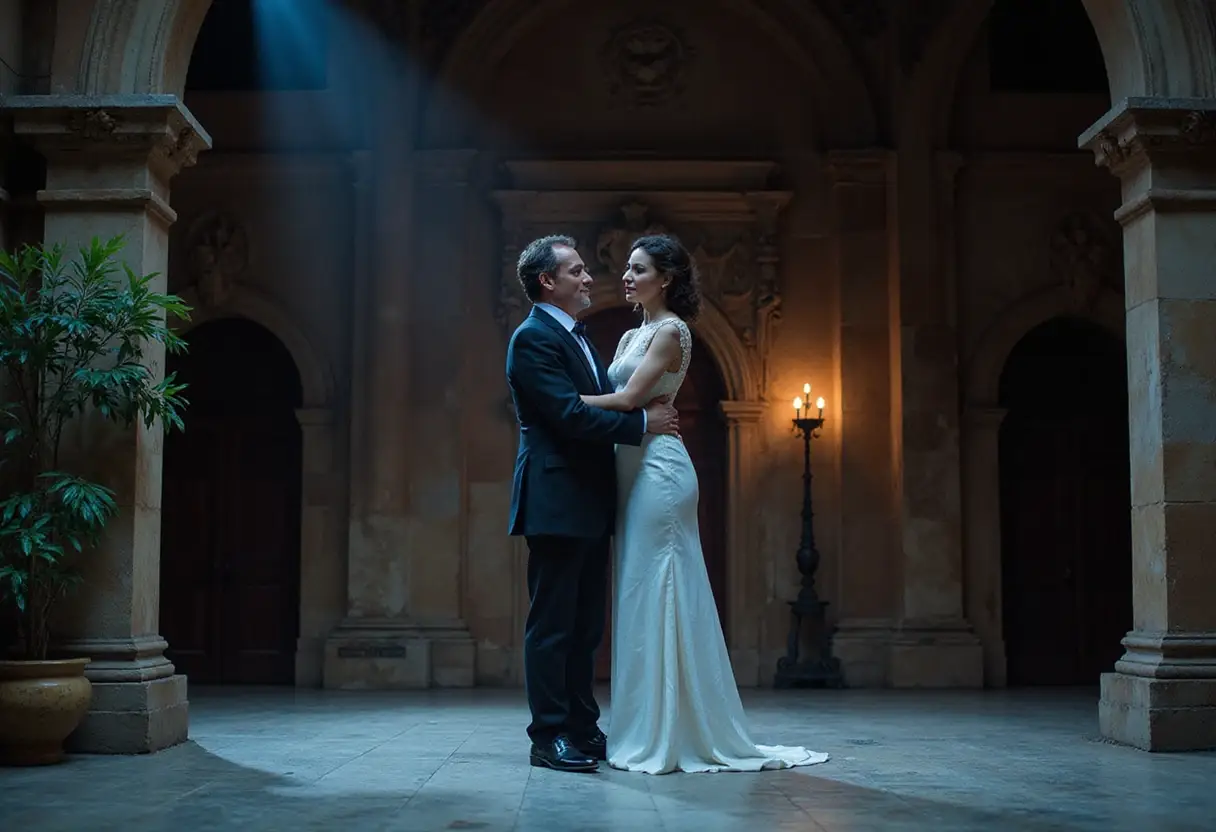
For this run, the Liceu imported a production originally mounted by the Opéra Royal de Wallonie-Liège, directed by Allex Aguilera. The sets were stark and stylized: castle walls flanking the stage and a monolithic rotating cube at its center, hollowed out on one side into a bleak architectural box — perhaps intended to symbolize the weight of social convention pressing on the lovers. Perhaps. The production did not say.
The action was shifted from the 14th century to the opera's premiere year of 1830, a displacement readable only through the men's costumes; Giulietta wore distinctly more modern gowns. The time shift served no discernible dramatic purpose. The visual world was uniformly gloomy, sparse and prop-less. The verdict: bland and uninspired, though with the saving grace of being completely harmless — which at least let the musical forces take center stage unhindered.
They responded. In the pit, Riccardo Frizza led the Liceu orchestra with elegance and a profound, idiomatic command of bel canto style. His interpretation was refreshingly understated, perhaps bordering on cool, yet executed with meticulous detail, relentless forward drive and constant support for the singers. The harp cut through the texture with crystalline beauty in Giulietta's opening aria. The Liceu male chorus performed with exemplary precision and wide dynamic variety, driving the drama with thrilling authority.
Two vocal triumphs, two uneven colleagues
Oropesa threw herself into Giulietta, as has become her trademark. Her liquid, silvery soprano dazzled the house; her trills were astonishingly fast, her coloratura crisp, her chromatic scales flawless, her high notes naturally brilliant. Her Act two aria "No, non poss'io partire" carried a heartbreaking pathos that held the audience spellbound.
Lupinacci's Romeo combined an alluring vocal palette with commanding stage presence — a bronzed low register acquiring metallic intensity on the way up, blossoming into radiant, powerful high notes. Her entrance aria "Se Romeo t'uccise un figlio" was a great account, but her highlight came in the Act one duet "Sì, fuggire," where her expressive legato forged electric chemistry with Oropesa.
The male principals did not scale those heights. Iván Ayón-Rivas sang Tebaldo with healthy projection and squillo-rich high notes, yet his muscular, aggressive delivery sat uncomfortably within bel canto's delicate ecosystem; his duel-scene confrontation with Lupinacci nonetheless proved dramatically effective. Marko Mimica, a career bel canto specialist as Lorenzo, seemed strangely out of focus and stylistically wayward, though his bass remained richly projected and fundamentally beautiful. Alejandro López's Capellio lacked refinement, occasionally deteriorating into unappealing shouting, though his solid projection anchored the choral ensembles.
What does this change for Barcelona's opera season? The Liceu has, in Oropesa and Lupinacci, a pairing strong enough to survive weak direction — but on this evidence, the house's bel canto credentials rest on its singers and Frizza's pit, not on its imported staging choices.
Source: Opera Wire
More from Tom Whitfield
Show full bio
Market editor covering people, launches and day-to-day practice in arts in the broadest sense at Arts & Voices.
1,285 articles