More than 60 artists map Puerto Rican abstraction beyond Puerto Rico
More than 60 artists from several generations and continents meet across four MACPR galleries in a show that treats Puerto Rican identity as a condition of movement, not a fixed address.
Programme
- More than 60 artists appear across four galleries at MACPR.
- The exhibition opens September 26, 2026, and runs through May 2027.
- Curator Abdiel D. Segarra Ríos built the show from a decade of research.
- Works come from El Museo del Barrio, MACPR’s Permanent Collection and new commissions.
- Many El Museo del Barrio works appear in Puerto Rico for the first time.
By Daniel Okafor
More than 60 artists will occupy four galleries at the Museo de Arte Contemporáneo de Puerto Rico from September 26, 2026, through May 2027.
Curated by Abdiel D. Segarra Ríos, Diasporican Abstraction: Identities Beyond Representation brings together work from several generations and geographic backgrounds. The show concludes a decade of research behind Segarra Ríos’s curatorial approach.
The artists’ trajectories extend from Puerto Rico to the United States, Canada, Europe and Australia, and intersect with those of artists from the Caribbean, Central America and South America.
What does “diasporic” mean here?
Curator Abdiel D. Segarra Ríos frames the premise with a question: “What happens when our understanding of Puerto Ricanness is no longer organized around territory?”
Here, “Puerto Ricanness” means a Puerto Rican identity that crosses territorial borders. “Diasporic” describes geographical dispersal alongside continuing ties to a shared origin.
In the exhibition’s argument, movement and belonging can generate visual languages of their own, independent of physical presence or allegiance to a country’s shared imaginary or visual repertoire. Abstraction (nonliteral art) becomes the method for testing that claim.
How is the show organized?
Instead of a chronology of Puerto Rican abstraction in the diaspora, the exhibition proposes a web of relationships conceived as ecosystems (overlapping networks of artists and ideas) across the four galleries.
The four galleries resemble an atlas spread across a table, not a sequence of national chapters. The exhibition moves beyond the categories through which art history is usually written. It rejects that tidy filing.
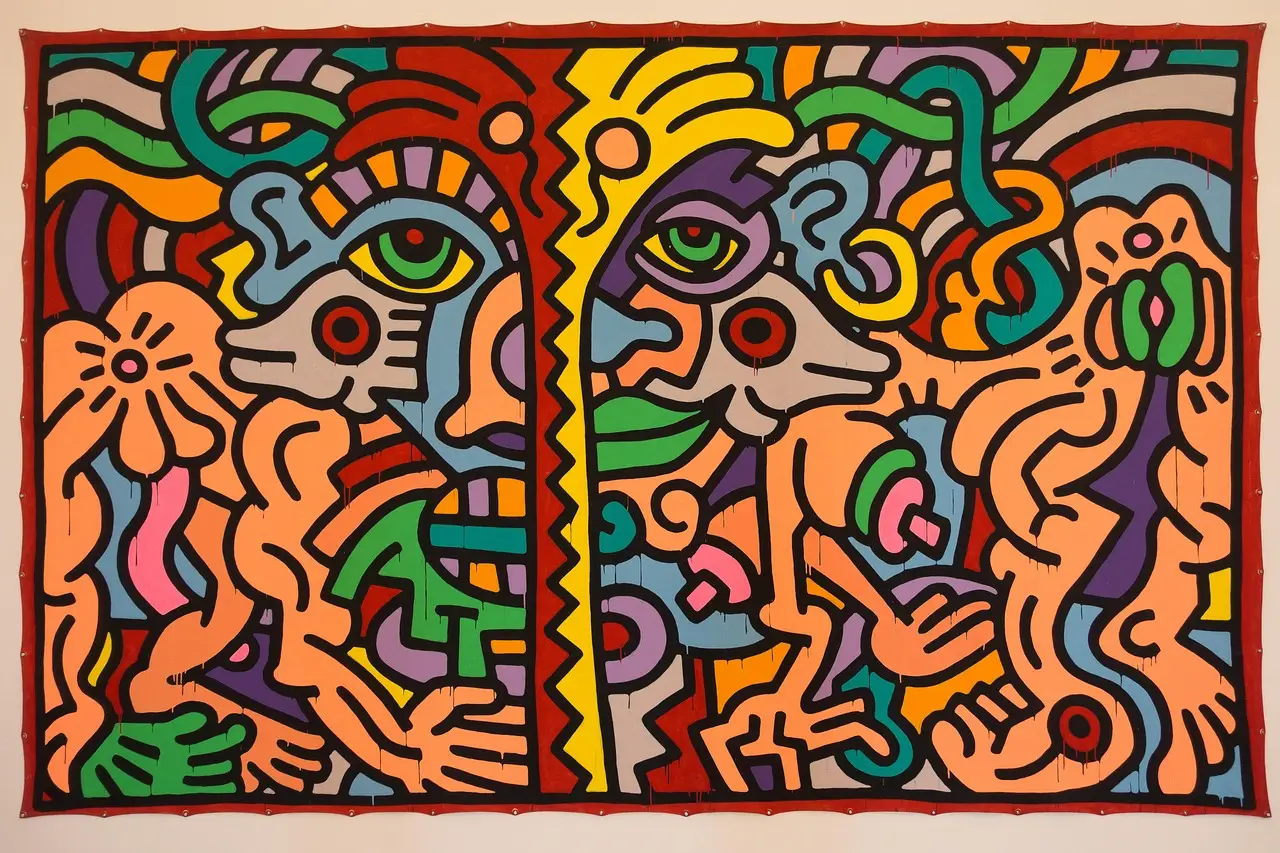
The works span generations and share concerns with color, form and materials. Other shared concerns include territory, ancestrality (relations to inherited family or community histories), corporeality (the body’s presence) and the natural and built environment.
The structure questions the need for strictly Puerto Rican, Caribbean or American narratives about abstraction. It also treats geographical location and national allegiance as incomplete guides to artistic identity.
Which artists appear?
The exhibition materials name twelve artists:
- Olga Albizu; Candida Álvarez; Rafael Ferrer; Ivelisse Jiménez; Zilia Sánchez; Edra Soto.
- Gisela Colón; Nayda Collazo-Llorens; Tony Bechara; Awilda Sterling Duprey; Lee Quiñones; Ángel Otero.
They appear alongside fifty other artists from different generations and backgrounds. Rather than simply redrawing the geographic boundaries of Puerto Rican artistic production, they use abstraction to dislocate identity from territory and reconstruct it through several forms of belonging. Their work questions the cross-border realities of Puerto Ricanness.
What happens when the collections meet?
The exhibition sets three groups of material beside one another:
- Works from El Museo del Barrio’s collection in New York, including many shown in Puerto Rico for the first time.
- Pieces from MACPR’s Permanent Collection.
- New commissions.
The encounter seeks greater visibility for artists and aesthetics marginalized in the construction of Puerto Rican art narratives. It invokes “the promise of return,” which the curatorial framing locates within the diasporic experience.
The curatorial argument rejects the idea that Puerto Rico is singular or has an immutable center. The exhibition makes Puerto Rico’s apparent center depend on who looks and from where.
When the exhibition opens on September 26, 2026, its four galleries will test a difficult proposition: that movement and belonging can sustain a visual language without a territorial anchor.
Visitors will have to judge whether the web of relationships holds in practice. The exhibition runs through May 2027. For an art history accustomed to fixed national categories, that is a substantial errand.
Original: bit.ly
More from Daniel Okafor
Show full bio
News editor covering companies, deals and strategy in arts in the broadest sense at Arts & Voices.
755 articles