Sammy Baloji Makes US Solo Debut at Wexner Center While Representing Congo in Venice
Sammy Baloji opens his first US solo show at the Wexner Center through February 2027 while appearing in the Venice Biennale's main show and Congo's national pavilion.
Programme
- Sammy Baloji's first US solo exhibition runs at the Wexner Center for the Arts in Columbus, Ohio, through February 14, 2027.
- At the 2026 Venice Biennale, Baloji shows three sculptures and 16 collage prints in the main exhibition and in Congo's national pavilion.
- His breakthrough series Mémoire dates from 2006 and combines colonial archival images with contemporary views of Lubumbashi.
- In 2008 Baloji cofounded the Picha Art and Research Center and the Lubumbashi Biennale, whose ninth edition opened in October.
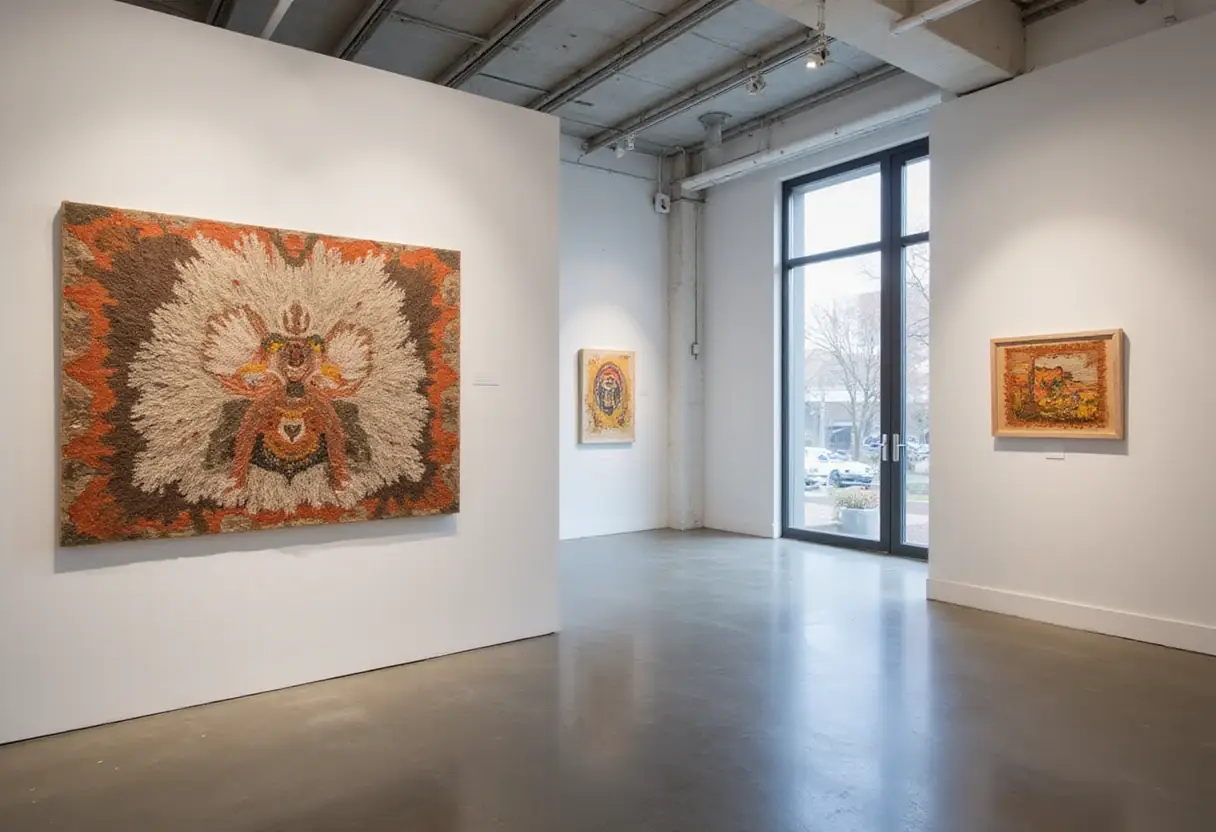
- New works at the Wexner include Suspension, built from mining and construction waste, and the tapestry Rethreaded Indies (2025).
Sammy Baloji, the Congolese artist who has spent two decades exposing the colonial extraction history of the Democratic Republic of Congo, is showing on two major stages at once: his first US solo exhibition opened at the Wexner Center for the Arts in Columbus, Ohio, and his work appears in both the main exhibition and the national pavilion of the Democratic Republic of Congo at the Venice Biennale.
The Wexner show, "When Extraction Becomes Form It Speaks In Borrowed Tongues," runs through February 14, 2027. It examines how Europe's decorative arts and architecture still carry elements of Congo's colonial history and the extraction of its natural resources. The exhibition takes a critical look at the impact on land, people and cultural forms, addressing the entangled relationships between Central Africa, Europe and the Americas.
What is Baloji showing in Venice?
In the Biennale's main exhibition, curated by the late Koyo Kouoh, Baloji presents three sculptures and 16 collage prints. Two of the sculptures reference works from a 19th-century Belgian colonial museum and the national collection assembled in the 1970s by former Congolese President Mobutu Sese Seko.
"I started to realize that the colonial system was not just about controlling territory but also occupying societies and imposing new rules," said Baloji, who splits his time between Brussels and Lubumbashi.
The pairing of archival and contemporary references is the method he has used since his breakthrough series. His early project Mémoire (2006) combined colonial-era black-and-white archival images with color photographs of contemporary Lubumbashi in Katanga, a province rich in copper, uranium, lithium, diamonds and cobalt.
How did the French Institute shape his practice?
After completing a master's degree in information sciences and communication at the University of Lubumbashi in the mid-2000s, Baloji began working with the French Institute in the city. Its director collaborated with academics researching colonial architecture and cultural heritage, and Baloji photographed events and worked with visiting French researchers.
The experience, he recalled in an interview with ARTnews, "really shifted my perspective, in terms of outlining photography or research, because I was interested in the way that [the researchers] were addressing the city or buildings or cultural heritage from a historical and objective perspective. I was mainly interested in people's experiences, the testimonies of people who are living [in Lubumbashi like] myself."
The tension between the two approaches produced a central question for his art: how to "use the so-called scientific objective materials and bring them close to the human experience, to the architecture of local sites."
What new works anchor the Wexner exhibition?
The Columbus show includes Suspension (Debris of History, Matters of Memory), a commission conceived with architect Gloria Cabral and developed in collaboration with art historian Cécile Fromont. The suspended large-scale sculpture draws on the design of historical Kongo cloth and is built from mining and construction waste, including debris from recent work at the Wexner Center itself.
Baloji and Fromont also created a new tapestry, Rethreaded Indies, which addresses the French Old Indies tapestry series (1637–1730), produced at the royal Gobelins manufactory in Paris, and connects it with Kongolese weaving. Both works use textile and architecture to correct misinformation about African histories and show how European colonization shaped the continent's narratives.
"I would say my interest in his work is how he weaves these histories together, and in a way that I find extremely compelling," said Julieta González, the Wexner Center's head of visual arts and curator of the exhibition. Baloji's work, she added, "is important because it weaves together so many historical events and situations but with materiality that speaks to the particular situation he's critiquing, which is the legacies of colonialism" in the DRC. The show, she said, offers the public "an insight into [the artist's] very research-oriented practice and how it unfolds in so many different mediums [which includes] video, sculpture and photography."
From Lubumbashi to institutional builder
Baloji was born in 1978 in Lubumbashi and grew up with limited knowledge of Belgium's colonization of the Congo; he connected resource extraction in Katanga to global history later, partly through reports that Congo had supplied Iran with uranium, which the country denied. In secondary school he cofounded a collective that shared books from accessible libraries, and he was drawing — producing some of his earliest artworks.
His parents did not encourage his plan to study at the Fine Art Academy, so he pursued information sciences and communication instead. The course he took to appease his parents ended up formative to his practice.
In 2008, he cofounded the Lubumbashi-based Picha Art and Research Center and the Lubumbashi Biennale, whose ninth edition, cocurated by Congolese-Belgian curator Sorana Munsya and Ethiopian-Eritrean-Italian artist Jermay Michael Gabriel, opened in October. Both platforms expand access to the arts and support local artists with infrastructure the state does not provide.
Camille Ostermann, an independent art consultant who worked on Congo's Venice pavilion, said: "In a city shaped by mining, by what is extracted and carried elsewhere, Picha does the opposite: it builds, gathers, gives back. Many artists told me their paths had been changed by Picha and Sammy's mentorship. Like Ibrahim Mahama in Tamale or Yinka Shonibare in Lagos, Sammy works internationally while staying rooted in Lubumbashi, deliberately keeping the two connected: what he builds abroad can open doors for others at home."
For Baloji, the biennial extends his artistic research directly. It can open conversations about extractivism and ecological crisis, he said, and address "the impact of international and economic interests on the environment and societies" — a statement that could describe nearly everything he makes. With Venice and Columbus running concurrently, that critique now reaches both European and American audiences for the first time at solo-exhibition scale.
Original: wexarts.org
More from Elena Vasquez
Show full bio
Senior reporter covering technology and product news in arts in the broadest sense at Arts & Voices.
1,685 articles